
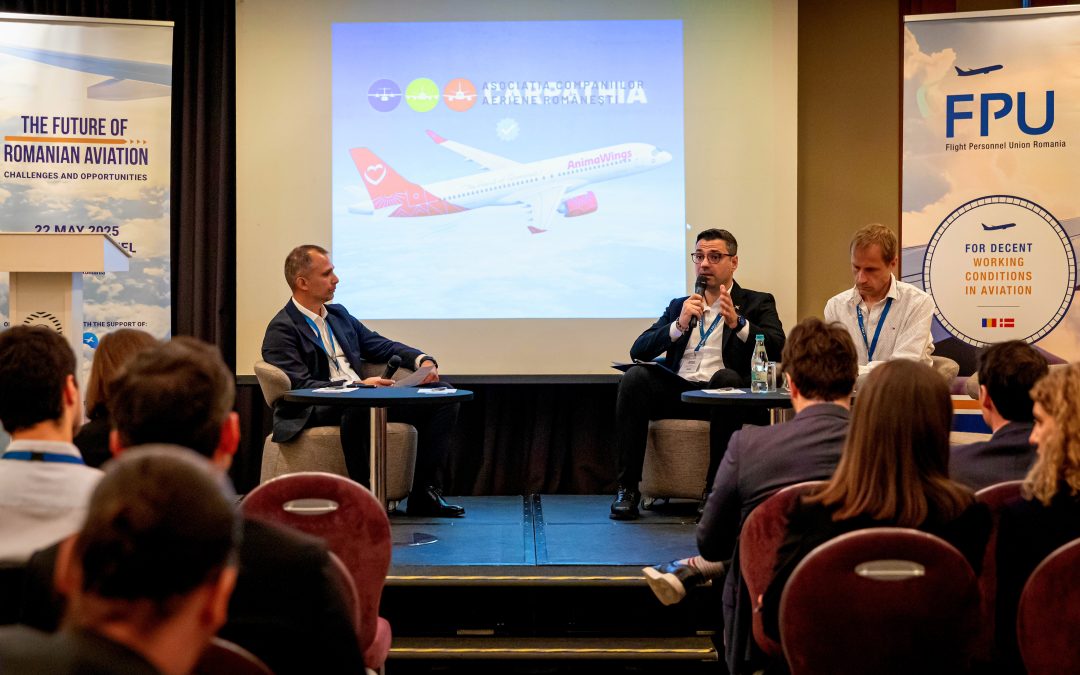
A rare event for Romanian civil aviation took place in Bucharest: “The Future of Romanian Aviation – Challenges and Opportunities.” Organized by the Flight Personnel Union Romania (FPU) with the support of the European Cockpit Association (ECA), the conference proved to be a turning point, not only through the relevance of the topics addressed, but especially through the caliber of its participants. It clearly signaled that Romania is no longer viewed merely as a peripheral labor market, but as a partner with genuine potential in shaping European aviation.
Romania, increasingly present in the European dialogue on the future of civil aviation
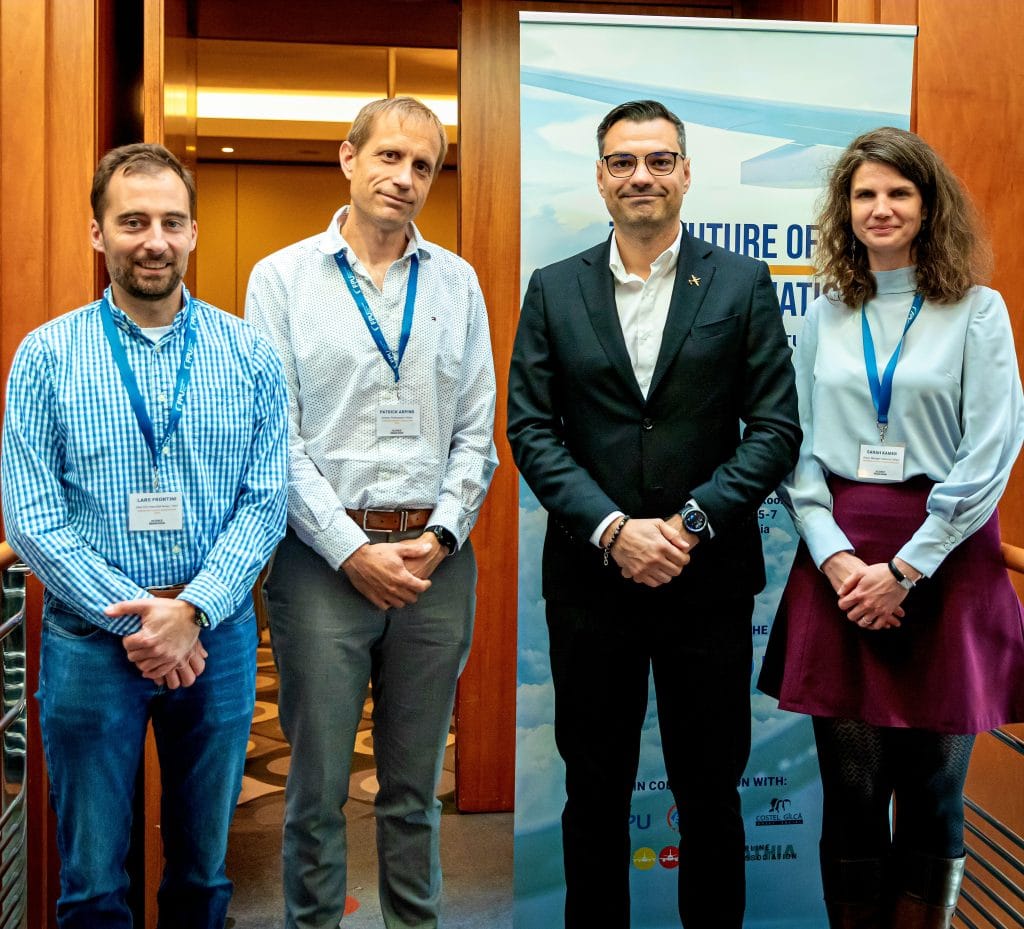
Lars Frontini (Lufthansa Group), Patrick Arpino (ECA și SNPL), Marius Popescu and Sarah Kamer (ECA)
Taking part in this event, we can say we were joined by highly respected professionals:
- Patrick Arpino, board member of the European Cockpit Association (ECA), an organization representing over 40,000 pilots from 33 European countries and Vice President of the Syndicat National des Pilotes de Ligne, the largest pilots’ union in France, with approximately 4,500 active members working for airlines such as Air France, Transavia, and Air Caraïbes.
- Sarah Kamer, Transnational Affairs Coordinator at the European Cockpit Association, plays a key role in shaping ECA’s policies on labor markets, transnational mobility, and working standards across the European Union.
- Lars Frontini, board member of the Vereinigung Cockpit, the main pilots’ union in Germany, representing approximately 9,600 pilots, most of them employed by Lufthansa Group, Condor, and Eurowings. He also serves as Vice Chair of the Lufthansa Group Company Council, an employee representation body covering the entire group, which includes over 100,000 staff members.
- dr. phil. Sandrine Nikolic-Fuss, leader of Kapers, the cabin crew union in Switzerland, representing approximately 1,300 members from the national carrier Swiss and its subsidiaries. In addition, Sandrine serves on the leadership board of the International Transport Workers’ Federation (ITF), a global organization with over 700 affiliated unions representing more than 18 million transport workers. She also coordinates the ITF Civil Aviation Committee, the platform where global policies concerning the rights of civil aviation personnel are debated and developed.
This participation was not the result of a random context. Europe is paying close attention to what is happening in Romania, whether it's the availability of qualified personnel, the aggressive commercial practices of low-cost carriers, the restructuring efforts of certain companies, or the need for fair regulation in line with EU directives. These are people who shape European aviation policy and speak with authority on sustainability in aviation.
From dialogue to concrete commitments
During the panel “The Future of Romanian Aviation”, moderated by Mircea Constantin (Secretary General of Flight Personnel Union România) and joined by Patrick Arpino, we addressed the real challenges facing the industry: lack of state support, market instability, the difficulties Romanian airlines are facing, market fragmentation, and the growing gap between Romania and the EU average in terms of sustainability and competitiveness.
We didn’t just talk about problems, we discussed solutions as well. The Romanian Airline Companies Association has initiated an official dialogue with the European Cockpit Association, aiming to sign a cooperation agreement focused on European integration efforts. The objective is clear: access to European know-how, participation in joint projects, and support for Romanian airlines in their reform and adaptation efforts to meet the requirements of the unified market.
At the same time, discussions were initiated with the European Transport Workers’ Federation to bring to Romania best practices in crew training, labor standards, collective agreements, and legal protection mechanisms.
In parallel, RACA continues to pursue its strategic priorities for 2025: defending the interests of Romanian airlines, supporting legislative initiatives to combat social dumping practices used by certain low-cost operators, and promoting a fair fiscal framework for domestic carriers. Integration into European networks is a necessary step to effectively advocate for these objectives at the political level.
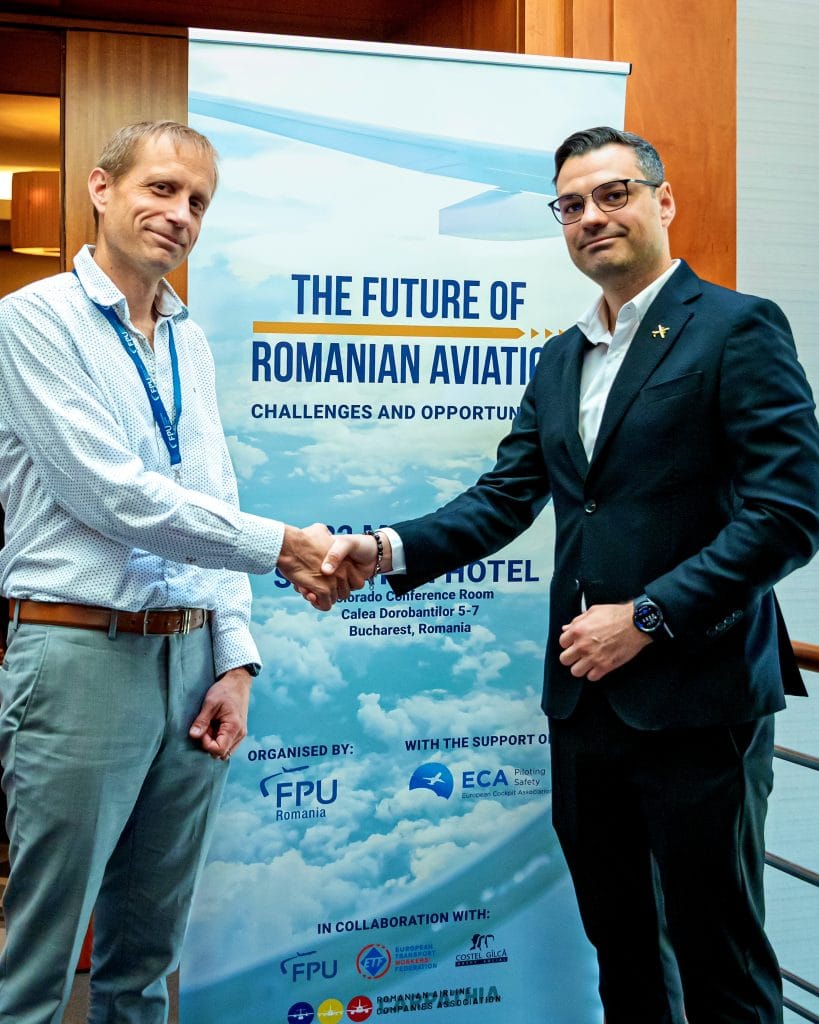
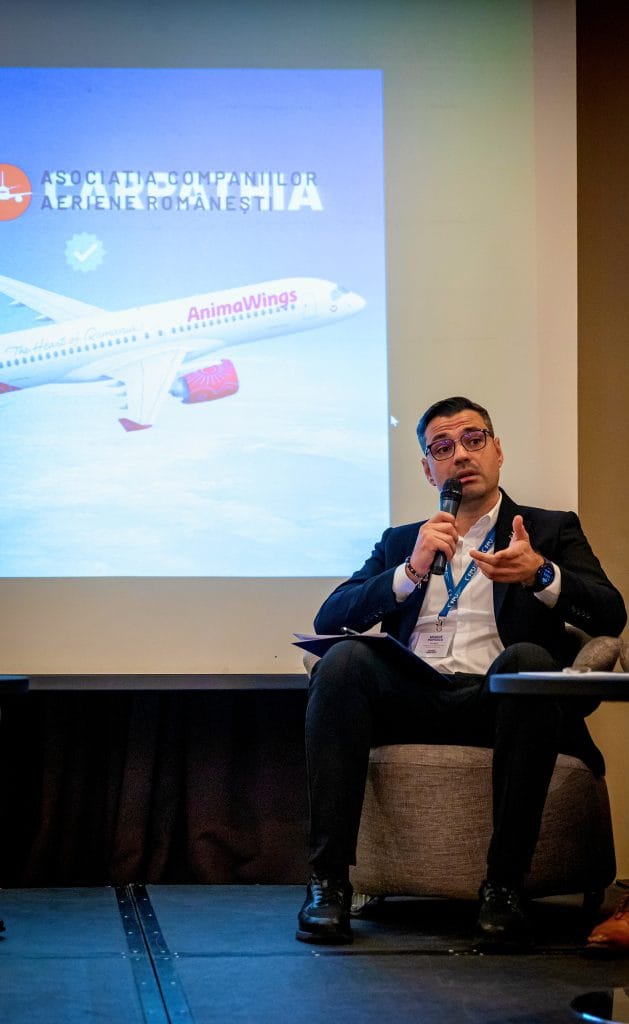
Patrick Arpino, board member of the European Cockpit Association (ECA) and Vice President of the Syndicat National des Pilotes de Ligne, the largest pilots’ union in France, with approximately 4,500 active members.
Romania needs partners, not spectators
A strong message came from Sandrine Nikolic-Fuss, who emphasized that stability and fairness in aviation are key pillars of sustainability. We cannot build a healthy aviation industry in Romania as long as flight personnel are treated selectively. It was clearly stated that there is a need for clear legislation, fair contracts, and institutions that support and uphold this balance.
Aviation is no longer a national game, it is a European ecosystem. Romania needs more than alignment with EU legislation; it requires investment in aviation workforce training, digital infrastructure, and the transition toward sustainable air transport. In this regard, we will support the adoption of measures that facilitate access for Romanian airlines to European funding dedicated to green transition and digitalization in aviation.
It is unacceptable that in 2025, a European Union member state with nearly 20 million citizens and a solid aviation legacy does not have a say in key policy files in Brussels. For this reason, RACA is making a clear commitment: active involvement in all relevant European forums and consistent representation of the interests of the Romanian aviation industry.
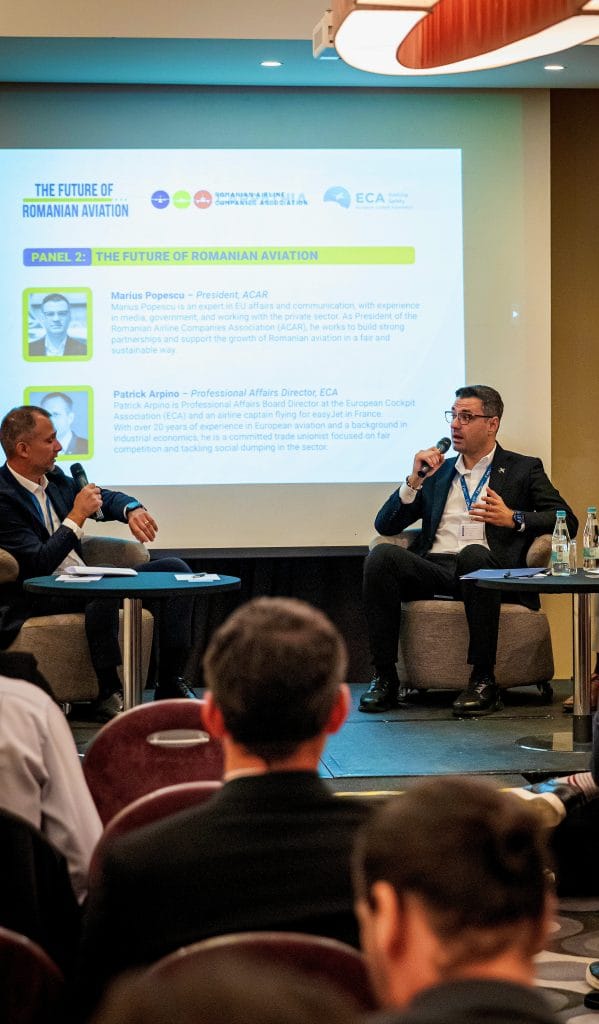
Mircea Constantin (FPU Romania) and Marius Popescu (RACA)
Partnerships, not isolation
Participation in the conference was not merely a symbolic gesture, it was a repositioning. We engaged in open discussions about our role in upcoming meetings of the ECA, ITF, and ETF, as well as in broader European events where key policies on human resources, sustainability, and competitiveness in the aviation sector are being shaped.
We also agreed to work on a common framework for developing standards tailored to Romanian airlines, while remaining compatible with practices already in place in countries such as Austria, France, Germany, and Spain.
“Romanian Aviation is European Aviation” showed just how essential partnership truly is. We cannot build a sustainable industry without genuine social dialogue. It’s not enough for Marius Popescu to be the only one speaking. The examples shared by representatives of the Ryanair Transnational Pilot Group and the European cabin crew community prove that it’s possible: where there is collaboration, stability, and respect for people, there is also profitability and operational safety.
Conclusion: the future is being built now, not later.
The conference was a statement of intent from all those who believe that Romania must play an active role in the transformation of European aviation. Many thanks to the team at FPU Romania.
RACA will no longer accept a passive role. We will collaborate, propose, and build alongside our European partners. We will forge strategic partnerships. The future of Romanian aviation must not be one of mere survival, but of growth. Strategic growth.
We can no longer afford to remain isolated. It’s time to be present where decisions are made. And this first step, taken together with FPU, ECA, ITF, and European union leaders, proves that it’s possible. Romania has something to offer. We just need to commit to the direction ahead…