

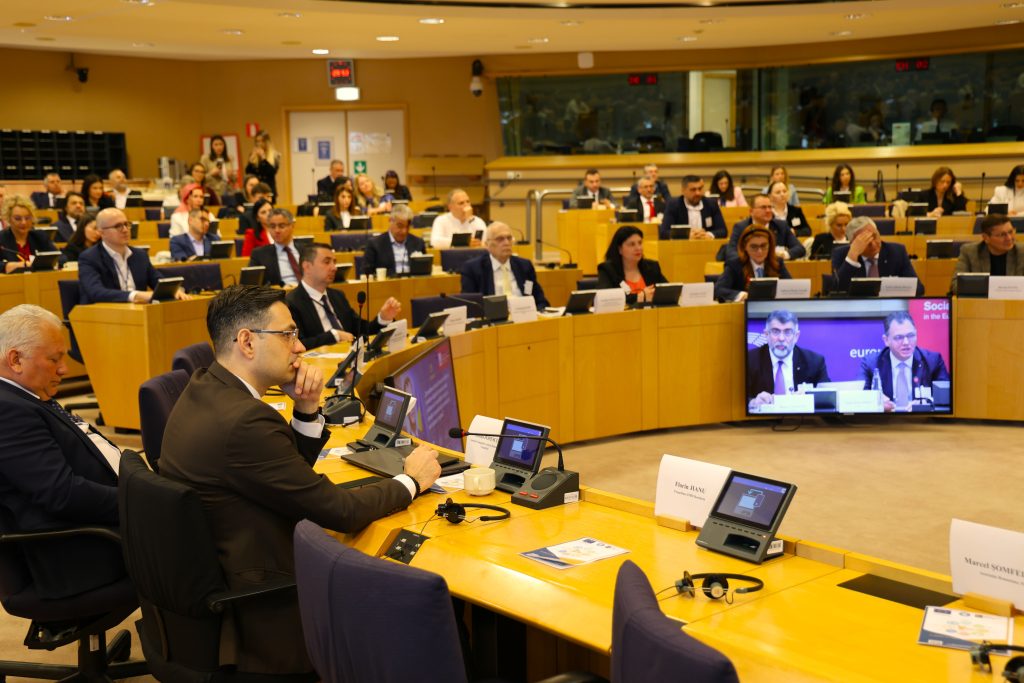
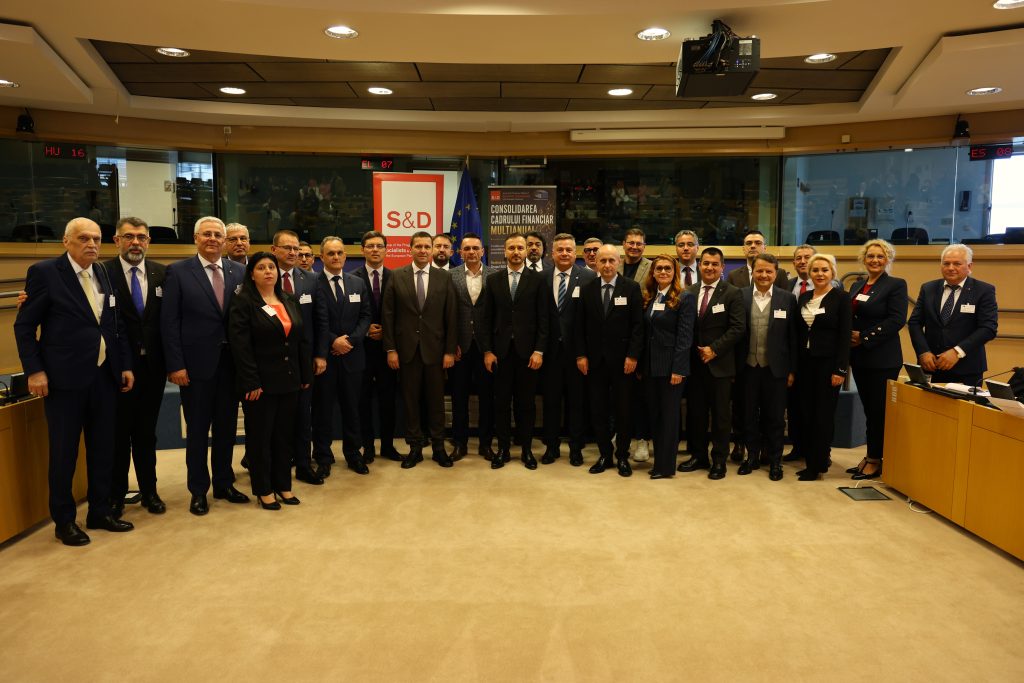
The Romanian Airline Companies Association "Carpathia" (RACA) participated on 12 May 2026 at the European Parliament in Brussels in the conference "Strengthening the Multiannual Financial Framework to meet the current and future needs of local communities and boost economic competitiveness at national and regional level". The event, organised by MEP Ștefan Mușoiu, member of the Committee on Transport and Tourism (TRAN), and co-organised by Victor Negrescu, Vice-President of the European Parliament, brought together political leaders, regional authorities, private sector representatives and European Commission officials.
Marius Popescu, President of RACA, spoke during the third panel of the event "Private Sector Access to European Funding and Growth Opportunities", alongside representatives from the Romanian business community and professional associations. The presence of Bogdan Costaș, CEO of TAROM, in the room underlined the strategic significance of the moment and the need for the Romanian aviation industry to speak with one voice in its engagement with European institutions.

The Dual Existential Pressure: ETS and Fuel Costs
RACA's intervention was grounded in a difficult operational reality: Romanian air operators are simultaneously facing jet fuel prices at historic highs and the gradual phase-out of free CO₂ allowances under the EU ETS (Emissions Trading System , whose compliance calendar has significantly accelerated in recent years.
The combination of these two factors is generating unprecedented financial pressure on companies across the industry, with a direct impact on their capacity to invest and, consequently, on Romania's regional connectivity.
RACA formally requested a temporary suspension of these charges during the technological transition period. This is not a request for a permanent exemption, but for a buffer mechanism that would allow operators to remain economically viable until green technical solutions, electric and hybrid aircraft, become available at commercial scale.
The "Technology Bridge 2026-2028": RACA's Call for the MFF
The second key message of ACAR's intervention addressed a structural contradiction in the logic of current European funds: next-generation aircraft (the latest Boeing and Airbus series), which immediately reduce fuel consumption and CO₂ emissions by 15–20% compared to the models they replace, are being rejected from European funding schemes on the grounds that they do not meet the "zero emission" criterion.
This approach, while understandable from the perspective of long-term climate goals, risks blocking the very transition it aims to promote. The first commercially certified electric aircraft with 40-seat capacity and hybrid models are expected in the 2028-2029timeframe. Without support for transition fleets in the 2026-2028 window, Romanian operators will no longer have the financial resources to invest in those technologies when they become available.
RACA put forward two concrete requests, formally addressed to DG REGIO representatives present at the event:
-
Bridge financing within the Multiannual Financial Framework (MFF) for the acquisition of more efficient aircraft during the transition period, with eligibility criteria based on percentage emission reductions rather than an absolute zero threshold
-
Recalibration of the Modernisation Fund to include private civil aviation as an eligible sector, in recognition of its contribution to emissions reduction and territorial cohesion
Aviation as a Driver of Regional Competitiveness
RACA highlighted, before the leaders of counties, present at the event during the first panel, that aeronautical infrastructure and private operators serve as an economic multiplier for the regions they serve.
Local airfields are not merely dots on a map: they can become training centres for pilots and aeronautical technicians, support logistica „just-in-time logistics„ for the automotive and pharmaceutical industries in the region, and maximise the value of road infrastructure already built or under development (A0, A1, A2, A3, A6 motorways).
Efficient air connectivity is a necessary, though not sufficient, condition for regional economic competitiveness — an argument RACA consistently brings to its dialogue with national and European authorities.
RACA's Position: Partners in Transition, Not Obstacles
The Romanian aviation industry demonstrated, through the figures recorded in 2025 — 28.5 million passengers at national airports, a growth of nearly 10% compared to 2024 — that it has the capacity to manage sustained expansion. This growth must, however, be accompanied by a regulatory and financing framework that does not penalise the transition, but accelerates it.
RACA "Carpathia" will continue its dialogue with European and national institutions for a genuine level playing field : an environment in which Romanian air operators compete on equal terms with their counterparts from states with more permissive fiscal regimes, and where European funds become an instrument for building the future — not an administrative barrier.