
The aviation industry is going through a period in which fleet growth coincides with modest traffic trends. For airlines, this combination puts aircraft utilisation, operating costs and each route’s ability to generate sufficient revenue firmly in focus.
According to IATA, in the first nine months of 2026, global passenger traffic grew by just 0.3%, while capacity increased by 0.1%, compared with the same period in 2025. Traffic is measured in RPK — paying passengers multiplied by the distance travelled — and capacity in ASK — available seats multiplied by flight distance. IATA’s September 2026 report.
Meanwhile, an analysis published by Rob Morris, using Cirium data, points to 3.7% growth in the global narrowbody and widebody passenger aircraft fleet since the end of 2025. The fleet reportedly reached 23,123 aircraft at the end of September, an increase of 835. Rob Morris’s analysis.
The difference warrants attention, but it needs to be interpreted correctly. Aircraft numbers and the capacity actually operated are different indicators. Flying hours, technical availability, cabin configurations and route lengths all affect the capacity each aircraft produces. Comparing the two percentages raises questions about fleet productivity, without in itself demonstrating a uniform decline in efficiency.
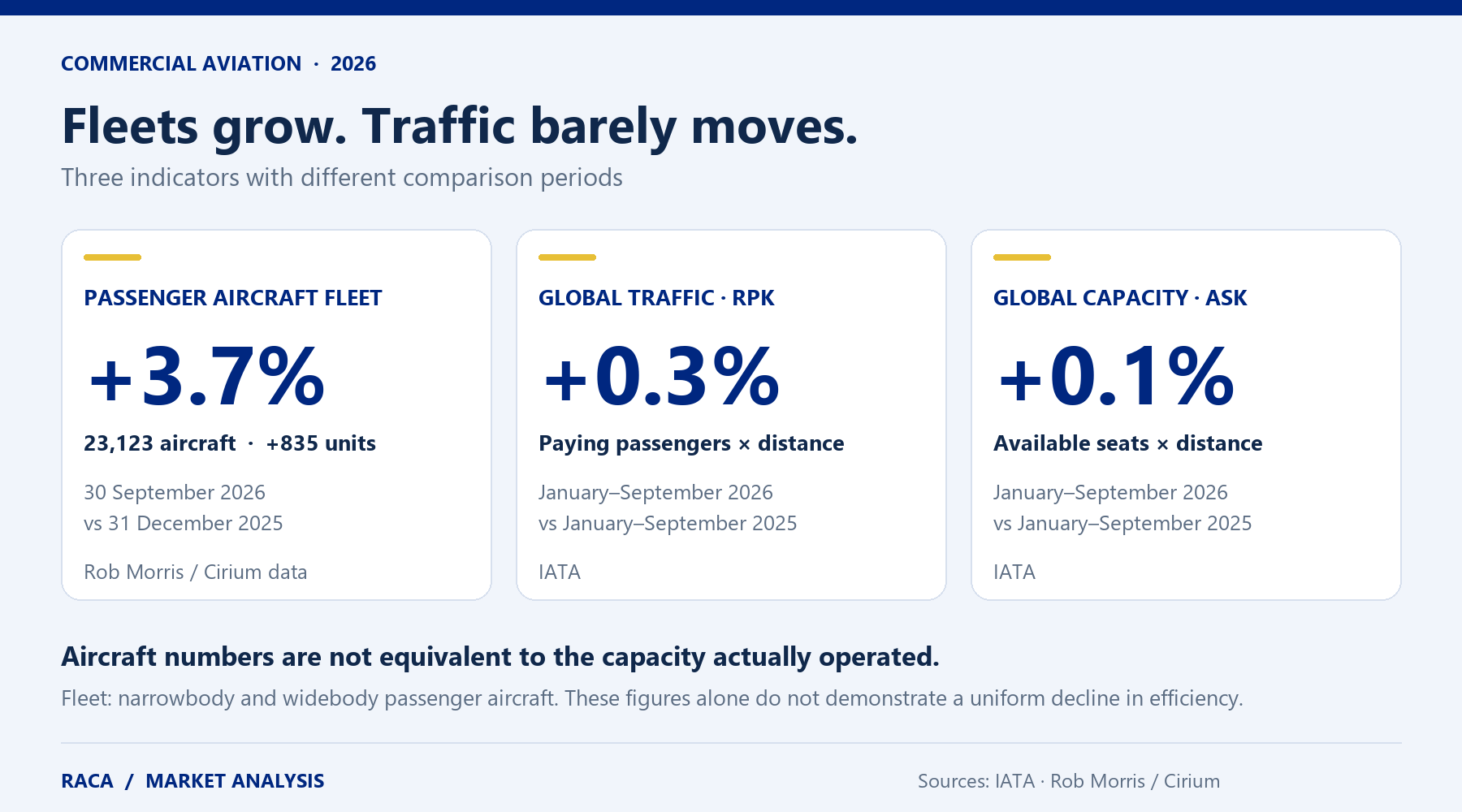
RACA infographic. Sources: IATA and Rob Morris’s analysis using Cirium data. The indicators use different comparison periods.
The analysis also highlights the scale of changes within fleets. Around 1,000 new aircraft were reportedly delivered, while 991 aircraft stored at the end of last year returned to service. Set against net growth of 835 aircraft, these additions suggest that more than 1,150 previously active aircraft left passenger service through storage, part-out or conversion. The author stresses that the calculation is preliminary, including the assumption that all new deliveries are already in service.
These movements suggest that a substantial share of deliveries is supporting the replacement of existing aircraft in a market with limited scope for expansion.
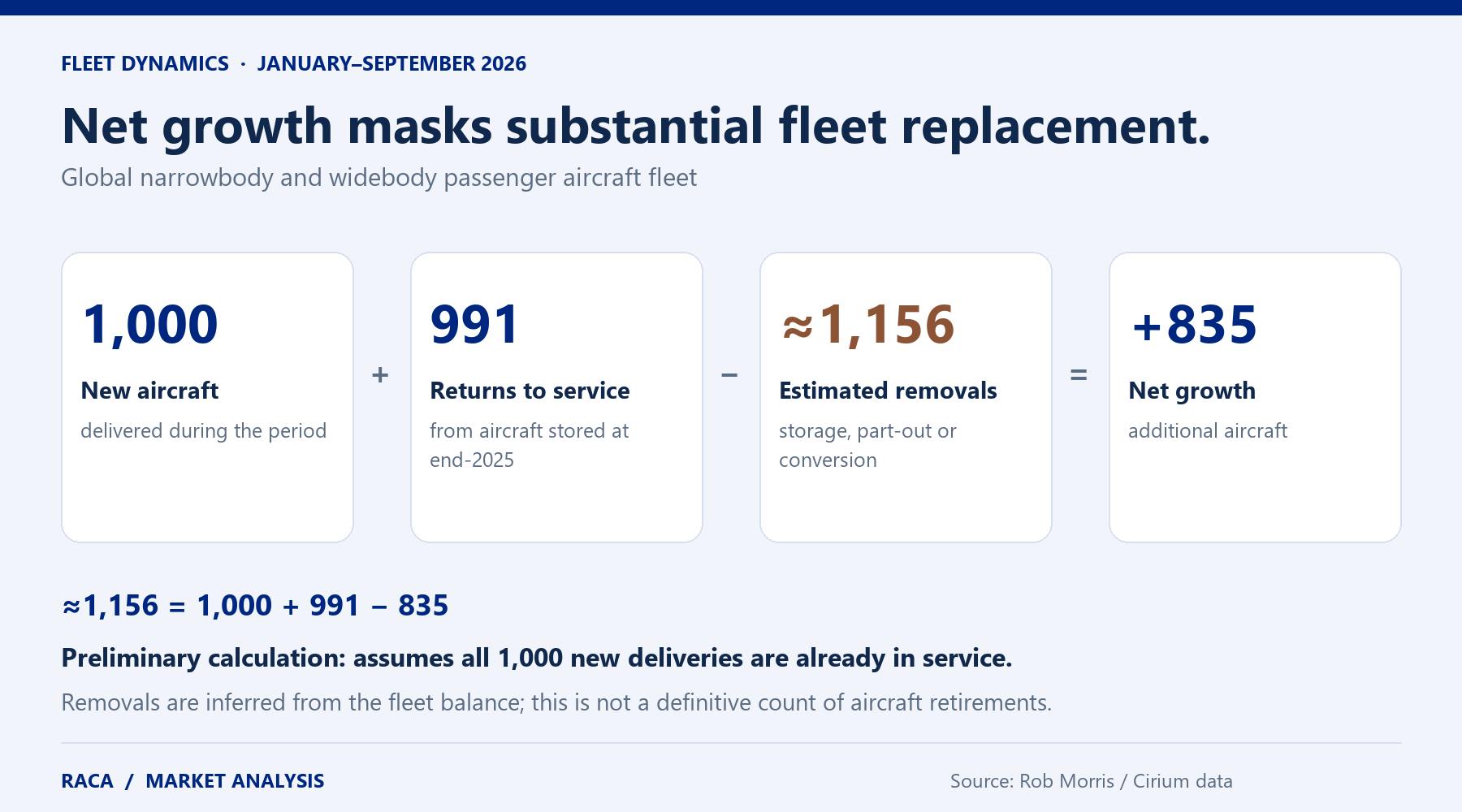
RACA infographic based on Rob Morris’s analysis / Cirium data. Removals are estimated by difference; the calculation assumes all new deliveries are already in service.
High fuel prices strengthen the economic case for replacement. A more efficient aircraft can reduce fuel burn and cost per available seat kilometre, known in the industry as CASK. However, fuel savings need to be weighed against lease payments, financing, maintenance and the cost of introducing a new aircraft type into the fleet. In its June assessment, IATA highlighted the simultaneous pressures arising from fuel, maintenance and access to capacity. IATA’s economic assessment.
In a nearly stagnant market, each additional aircraft needs a flight programme and revenues that justify its place in the fleet. A high load factor alone does not guarantee profitability: the revenue earned from passengers relative to the actual cost of operating the service also matters.
Rob Morris anticipates that these developments could put pressure on the values and lease rates of some older aircraft. This is a market outlook, rather than a decline already confirmed across all segments. Engine availability, technical condition and demand for each model can lead to different outcomes.
Traffic trends are not uniform either. In September, global demand fell by 0.5% compared with the same month in 2025, while European carriers’ international traffic grew by 1.8%. The global average therefore needs to be complemented by analysis of individual markets and routes. IATA’s September figures.
For Romanian operators, RACA considers it essential to align fleet plans with demand, technical availability and financial resources. In a small fleet, a single aircraft being unavailable or one route underperforming can significantly affect the results of the entire airline.
In this context, developing Romania’s connectivity requires well-founded investment and a predictable framework. Dialogue between operators, airports and public authorities needs to address the economic viability of routes, access to financing and fleet modernisation.
RACA promotes a competitive, connected and sustainable aviation sector in Romania, for the benefit of passengers and the national economy.
Cover photograph: Skyler Smith / Unsplash. Illustrative image.